Kpop Piano Beats - Music Game
- 4.7
- Rating
- 10.00M
- Installs
- Free
- Price

 Analysis by App-foxy
I noticed Kpop Piano Beats because it takes a familiar rhythm-game idea and gives it a clear K-pop focus. Instead of asking me to learn a full song, it turns the music into a stream of tiles that I tap in time. That makes it easy to understand within seconds, but the timing still gives the game enough tension to keep a short session from feeling completely automatic.
This is a free music game from Sonata Studio: Piano Rhythm, aimed at players who want quick, song-driven entertainment rather than a deep piano simulator. I found it most enjoyable when I treated each track as a small concentration exercise: listen, watch the pattern, and react without rushing. It is not a replacement for learning an instrument, and it is not the best choice for someone who wants a detailed music library or a realistic keyboard. Its appeal is more immediate: familiar pop energy, simple controls, and the satisfaction of surviving a faster sequence.
How the first sessions establish a goal
The opening appeal is straightforward. I tap the tiles as they reach the playable area, trying to stay with the beat and avoid breaking my run. The control scheme requires only touch input, so there is no long tutorial barrier or complicated layout to memorize. That simplicity matters on a phone, especially when I am playing for a few minutes rather than settling in for a long session.
You May Also Like

 Pandora - Music & Podcasts
Pandora’s Music Is Easy to Start, but Harder to Recover
Pandora’s strength is its low-effort path from a seed to a station. Its weak spot is how much confidence it asks you to place in connection, setup, and quiet recovery.

 8 Ball Pool
 Is Built on Rivalries, Rematches, and Routine
A close look at the rivalries, rematches, shared routines, and unanswered safety questions that turn a quick pool match into a persistent mobile community.

 Samsung Music
’s Quiet Strength Is Playing What You Already Own
Its reach comes less from spectacle than from dependable access to a personal library. That simplicity is both the app’s strongest retention engine and its ceiling.

 AccuWeather: Weather Radar
AccuWeather Review: A Quick, Clear Forecast for Everyday Decisions
For everyday plans, the best forecast is the one you can understand quickly. AccuWeather makes rain timing, radar, and local conditions easy to act on, with a few trade-offs.

 Hill Climb Racing
Why Hill Climb Racing Still Turns Crashes Into One More Run
A tiny car, a bumpy hill and one more upgrade: Hill Climb Racing keeps resurfacing because its simple chaos makes every near-miss feel personal.

 AliExpress - Shopping App
AliExpress Makes Global Shopping Feel Personal, but Shoppers Bear the Risk
AliExpress turns a global marketplace into a pocket-sized discovery engine. Its reach is useful, its shopping loop compelling, and its trade-offs easy to miss.
More From Our News Desk
View All News


The early goal is not merely to finish a song. I am also trying to improve my score and become more comfortable with the rhythm. A first attempt often feels like recognition: I learn where the game places taps, how quickly the pattern moves, and whether my attention slips during denser passages. On a second attempt, I can focus less on survival and more on cleaner timing.
That creates a useful short-term loop. I choose a track, play until I make mistakes or finish, then decide whether the result is good enough. If it is not, restarting feels natural because the controls are immediate and the commitment is small. I do not need to remember a complicated route or rebuild a character before trying again. The music itself provides the motivation to repeat a section.
The score also gives the early game a visible target. Even when I am not competing with anyone else, seeing a result after a song gives the session a clear ending. I can aim to beat my previous performance, protect a better run, or simply get through a difficult part that stopped me earlier. For casual players, that is more approachable than a large progression tree with many menus.
One practical tip is to avoid tapping harder just because the song becomes exciting. The game rewards timing, not force. I found that a light, consistent touch works better than stabbing at the screen, particularly when several tiles arrive close together. Keeping the phone steady also helps; shifting grip halfway through a pattern can turn a manageable sequence into an avoidable mistake.
The game is rated Everyone 10+, which fits the accessible rhythm format while still giving families a reason to check whether the music and pace suit a particular child. It is free to start, so trying the basic experience does not require an upfront purchase. Optional in-app purchases range from $0.99 to $2.99 per item, something I would keep in mind before handing the phone to a younger player.
What counts as progress during play
Progress here is communicated more through performance than through a role-playing-style character journey. I can feel improvement when a pattern that once seemed chaotic becomes readable. My hands begin to anticipate alternating taps, and I stop reacting to every tile as an isolated event. Instead, I read the shape of the sequence and follow the song’s pulse.
That is an important distinction. Players expecting equipment upgrades, a story campaign, or a carefully explained unlock map may find the progression light. The satisfying part is mastering the track and pushing the score, not collecting a complicated set of permanent advantages. I prefer that approach for a rhythm game because it keeps the result tied to my timing rather than to a stronger virtual item.
The music gives each attempt an emotional signal as well. A familiar K-pop-style arrangement can make a successful run feel more exciting than the same pattern would feel in a neutral sound test. When I miss a tile near a strong musical moment, the mistake is noticeable because it interrupts the flow I was trying to maintain. That connection between sound and input is where the game is strongest.
For a more disciplined routine, I would use three attempts per track. The first is for learning the layout, the second is for correcting the most obvious mistake, and the third is for chasing a cleaner score. This prevents endless restarting without reflection. It also makes the game feel more like practice, even though it remains a casual mobile experience.
Another useful habit is to play with the volume at a level where the beat is clear but not overwhelming. Visual concentration is important, yet relying only on the screen can make the game feel like a reaction test detached from the music. Listening for the pulse helps me prepare for changes instead of waiting until each tile is already on top of me.
The current version is 5.2.0, and the game has reached more than ten million installs. Its average rating is 4.6 from roughly 421 thousand ratings, with about 2.6 thousand written reviews. Those figures suggest that the basic formula connects with a large audience, although popularity should not be confused with depth. The game succeeds at quick rhythm play; it does not promise the breadth of a full music-learning platform.
Where the difficulty starts to matter
The difficulty curve is most noticeable when the tile patterns become faster or more crowded. At first, I can concentrate on individual taps. Later, that approach becomes inefficient. I need to track groups of notes, recognize repeated movement, and keep my eyes ahead of the tile I am about to tap. This is where the game changes from a simple touch activity into a genuine coordination challenge.
I appreciate that the challenge comes from execution rather than from complicated controls. There are no extra buttons to remember while I am already trying to stay on beat. The trade-off is that a missed input can feel unforgiving when I understand the song but cannot physically keep up. Players with slower reactions may enjoy the music but become frustrated if they expect every track to remain relaxed.
My best adjustment was to stop staring at the exact point of contact. Looking slightly above the immediate tapping area gives me more time to read the next movement. I also try to keep my fingers close to the screen instead of lifting my hand high after every tap. That small change reduces wasted motion during quick passages and makes longer attempts less tiring.
The game is particularly suitable for players who enjoy gradual personal improvement. Someone who likes rhythm titles because of perfect runs, repeated practice, and score chasing will find a reason to return. Someone who wants to relax while passively listening may not. The need to watch and react remains central, so the music cannot be enjoyed in the same hands-off way as a playlist.
It is also worth separating musical difficulty from touch difficulty. A song may sound familiar but still contain a pattern that demands more concentration than expected. Conversely, a busy arrangement can sometimes feel manageable if its rhythm is regular. I would judge a track by how clearly I can predict its tap flow, not just by how energetic it sounds.
Compared with a traditional piano-learning app, this game is far more forgiving about musical knowledge. I do not need to read notation, understand chords, or coordinate both hands across a keyboard. Compared with a conventional rhythm game using many buttons or a controller, it is more accessible but also less expressive. The single-touch format makes entry easy, while limiting the range of techniques I can develop.
Why the loop can hold attention, and where it presses too hard
The strongest retention tool is the short distance between failure and another attempt. I can immediately try again, and the song provides a reason to see whether I can do better. That works especially well during small breaks: I might play one track while waiting for an appointment, then stop without feeling that I abandoned a long campaign.
There is also a natural “one more try” effect. A mistake near the end makes a replay tempting because the solution seems close. This can be satisfying when I am actively improving, but it can also become repetitive if I keep restarting without changing my approach. I recommend setting a personal stopping rule, such as leaving after a clean improvement or after a fixed number of attempts.
The pressure is mostly self-imposed rather than narrative. I am not returning to discover the next story scene or manage a growing collection of characters. I return because I want a better run, a higher score, or another chance at a song I enjoy. That makes the game easy to fit into daily life, but it may not provide enough variety for players who need constant new systems to stay interested.
Free access lowers the barrier to experimentation, while the optional purchases create a point where some players may need to manage spending carefully. I would treat any purchase as a convenience or a personal choice, not as a requirement for understanding whether the core tapping is enjoyable. A good test is to play several short sessions without buying anything and see whether the basic loop already gives you a reason to return.
One realistic use case is a commuter with ten minutes before reaching a destination. I would choose a familiar track, play one attempt with sound on, and use the next attempt to correct the section where my timing slipped. If the environment is noisy, the visual pattern still helps, but the experience loses some of its musical character. For that situation, headphones can make the beat easier to follow, provided the player remains aware of the surroundings.
Another use case is a small social challenge between friends. Rather than comparing who knows the most about K-pop, players can compare how consistently they handle the same rhythm. The game works best in that setting when everyone agrees that scores are for fun, because differences in screen size, touch habits, and familiarity with the song can affect the experience.
Who should choose it over the usual alternatives
I would recommend this game to fans who want K-pop-flavored rhythm play without learning a complicated control scheme. It is also a good fit for people who like score improvement, quick retries, and games that can be understood immediately. Younger players within the age rating may enjoy the colorful, musical format, while adults can use it as a short concentration break.
I would point a serious music student toward a piano-learning app instead. Those tools are built around technique, exercises, notation, and structured instruction; tapping falling tiles does not build the same skills. I would also suggest a broader rhythm game to someone who wants multiple genres, deeper competitive systems, or more complex input methods. This title’s identity comes from keeping the interaction narrow and the music central.
It may not suit players who dislike repetition. Improvement depends on replaying songs and learning their patterns, so the same track can appear again and again during a focused session. It is also a poor choice if you want to play with the screen locked, listen without touching, or enjoy a story between musical stages. The game asks for attention every time it is active.
For accessibility, the simple tap control is a meaningful advantage, but speed can still be a barrier. A player who has difficulty with rapid touch input may prefer slower rhythm experiences or adjustable practice tools in another app. I would not choose this solely because it looks simple; the controls are simple, while the later timing demands can still be intense.
Battery and data habits are practical considerations for any music-heavy mobile game, but I would avoid treating it as a substitute for an offline music player. Its purpose is interactive play. If I am traveling, I would test the tracks and sound behavior before relying on it as my only entertainment, rather than assuming that every part of the experience will suit a poor connection or a quiet environment.
My verdict on the progression and pacing
My overall view is that Kpop Piano Beats understands its most important promise: give me an immediate way to interact with K-pop-inspired music, then encourage me to improve through timing and score. The early goals are clear, the progress signals are easy to read through better runs, and the difficulty becomes meaningful once I stop treating each tile as a separate reaction.
Its pacing is best when I play in short bursts or choose one track to master. The lack of a heavier progression structure is both a strength and a limitation. It keeps the game clean and approachable, but it gives me fewer reasons to continue when I have already exhausted my interest in a particular song or pattern.
I also like that the challenge remains connected to my performance. A purchase does not replace the need to watch the sequence and tap accurately; the core satisfaction comes from execution. At the same time, the free-to-play format means I would pay attention to optional purchases and avoid clicking through them casually, especially when a child is using the device.
Sonata Studio: Piano Rhythm has made a focused game rather than an all-purpose music platform. That focus is why I can recommend it to a friend who wants fast, approachable rhythm sessions and enjoys K-pop’s energy. I would skip it for someone seeking instrument training, a deep campaign, or a broad competitive ecosystem.
Released on August 30, 2023, and available for devices running Android 7.0 or later, it is easy to try without an upfront cost. After spending time with it, my advice is simple: start free, play with the sound clear, use deliberate retries instead of endless restarts, and judge it by whether improving a song feels rewarding. If that loop clicks, this is a lively little music game with enough challenge to earn regular short sessions.
FAQs for Kpop Piano Beats - Music Game
01What is Kpop Piano Beats - Music Game?
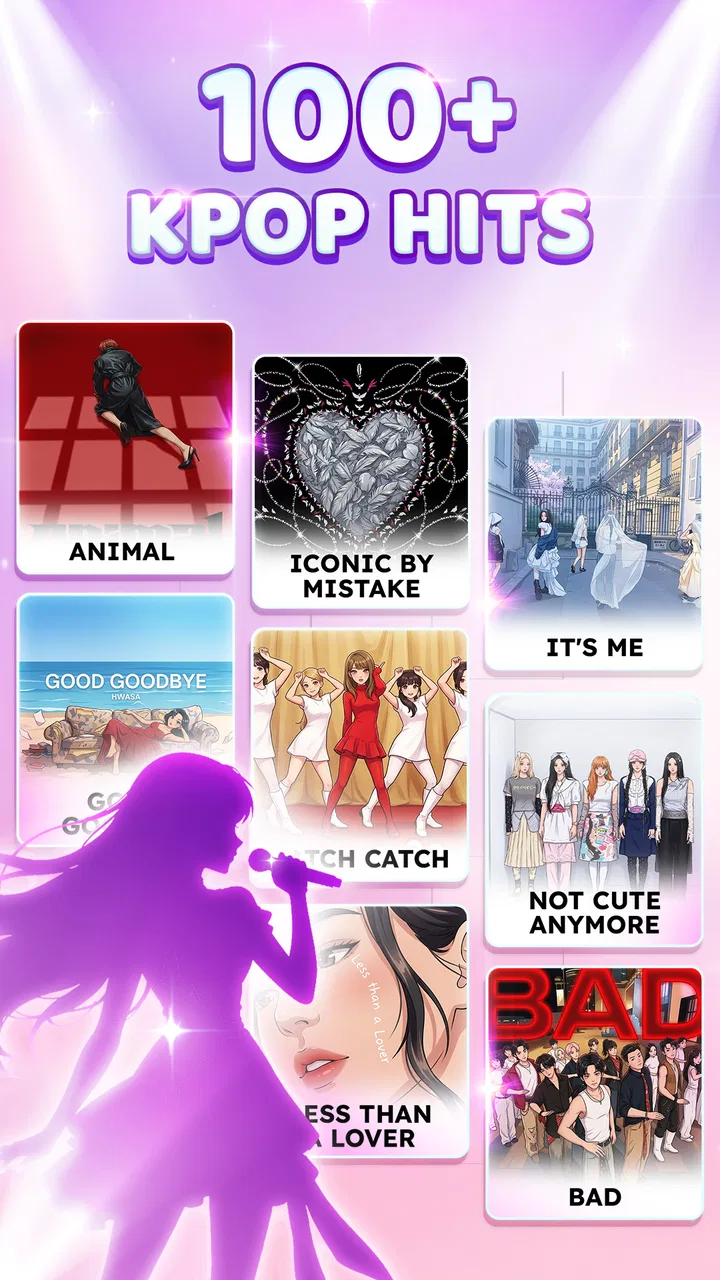
Kpop Piano Beats is a rhythm-based music game where players tap along to popular Kpop songs. The game challenges users to match the beats and rhythms of these tracks by tapping on the screen in time with the music. It’s designed for Kpop fans who enjoy interactive music experiences.
02Is Kpop Piano Beats suitable for all ages?
Yes, Kpop Piano Beats is suitable for all ages. The game features a simple interface and intuitive controls, making it accessible for children, teens, and adults. However, younger players may need supervision to ensure they are making appropriate in-app purchases, if any.
03Does Kpop Piano Beats require an internet connection?
Kpop Piano Beats can be played offline; however, an internet connection may be required for downloading new songs and updates. Playing online might also offer additional features such as leaderboards and social sharing, enhancing the gameplay experience.
04Are there in-app purchases in Kpop Piano Beats?
Yes, Kpop Piano Beats offers in-app purchases. These may include additional songs, themes, or gameplay enhancements. While the game can be enjoyed without spending money, some features may require purchases to unlock the full experience. Always check the settings to manage purchase permissions.
05What are the key features of Kpop Piano Beats?
Kpop Piano Beats features a wide selection of popular Kpop songs, intuitive tap controls, and various difficulty levels to challenge players of all skill levels. The game also offers a leaderboard for competitive play, allowing users to compete with friends and other players worldwide.
Pros
- Engaging gameplay with popular K-pop tracks
- Simple interface for easy navigation
- Regular updates with new songs
- Minimal ads for uninterrupted play
- Community features for sharing scores
Cons
- Limited offline play options
- Some tracks require in-app purchases
- Occasional lag on older devices
- High battery consumption during play
- No landscape mode available

Kpop Piano Beats - Music Game
Gallery